


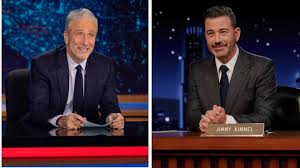
Late-night television returned from the Thanksgiving break with no shortage of material, thanks largely to President Donald Trump’s latest outburst on his social media platform. While many Americans were still digesting turkey leftovers, the president delivered a controversial Truth Social post targeting Minnesota Gov. Tim Walz with an ableist insult. By Monday, Dec. 1, the comedians who anchor the late-night landscape were back on air and eager to dismantle the remark—and the strange series of follow-up explanations Trump offered to the press.
Jimmy Kimmel wasted no time diving into the story. On “Jimmy Kimmel Live,” he opened with characteristic sarcasm, remarking, “I wonder why he didn’t get that Nobel Peace Prize,” as though Trump’s online name-calling somehow disqualified him from consideration for global honors. Kimmel’s joke set the tone for what quickly became a shared theme across the night: a mixture of disbelief, exhaustion, and exasperation at the spectacle of a sitting president using the holiday weekend to lob insults at political rivals while surrounded by family at Mar-a-Lago.
If Kimmel played the moment with sly amusement, Jon Stewart on “The Daily Show” approached it with more pointed frustration. Stewart, who has long served as a voice of comedic outrage, looked almost incredulous as he addressed Trump’s decision to unleash a slur on Thanksgiving Day. “On Thanksgiving?!” he shouted, stressing every syllable as though trying to shake some sense into the situation. He sympathized—sarcastically—with the beleaguered White House press corps, who spent their holiday stationed at Mar-a-Lago instead of at home. They were forced to monitor the president’s public statements and then follow him back on his return trip to Washington, all to ask whether he wanted to clarify any of the remarks he had just made.
Stewart then rolled a clip of Trump speaking to the press after the online post. Rather than retract the insult or soften its meaning, Trump doubled down, reaffirming his belief that “there’s something wrong” with Walz. Stewart’s eyes widened as the clip played, and as it ended, he burst out, “Something wrong with him? With him?” His voice rose with each word. For Stewart, the absurdity of the situation wasn’t just the slur itself—it was the idea that Trump, who had just spent a holiday surrounded by his family and supporters in a lavish resort, thought his first duty of the day was to attack a political opponent using language long recognized as harmful.
From there, Stewart zeroed in on what may have been the strangest subplot of the weekend: Trump’s recent MRI. According to the president, he had undergone the imaging scan, but said he had “no idea” which part of his body the doctors were examining. He insisted the scan couldn’t have been of his brain, since he had “taken a cognitive test” and “aced it.” That reasoning, Stewart argued, was its own kind of comedy. Staring into the camera with a look that was somewhere between disbelief and plea for help, Stewart said, “That’s not physically possible to have no idea.” He imagined Trump telling a doctor, “Don’t tell me, I want to find out at my MRI reveal party,” as though the medical procedure were some kind of gender-reveal celebration. The notion that a patient could be placed into an MRI tube for nearly an hour without ever asking what was being examined seemed comically implausible to the host. Stewart wondered aloud whether Trump assumed the machine was just an unusually loud tanning bed.
Stephen Colbert, hosting “The Late Show,” took the baton from Stewart and ran with it, weaving Trump’s comments into his own brand of satire. Colbert highlighted Trump’s line about not knowing what the MRI was scanning and teased that the confusion might be illustrative. “Maybe the part that’s broken is the part that’s supposed to know,” he joked. After playing the same clip in which Trump bragged once again about acing a cognitive test, Colbert slipped into a parody of the president’s voice: “I did so well on the cognitive, they put me in the extra credit tube.” The line landed easily with his audience, showcasing Colbert’s knack for twisting Trump’s words back on him through mimicry.
Kimmel later rejoined the comedic chorus, picking up on Trump’s boast that members of the press would be “incapable” of earning a perfect score on his cognitive exam. Kimmel, never one to miss an opportunity to poke fun at Trump’s self-image, responded with a smirk, “Wow, that Melania is a lucky lady indeed.” What followed was one of Kimmel’s signature visual jokes: a photograph of Trump mid-sentence, mouth hanging at an unflattering angle. “He looks fine to me,” Kimmel said, pretending to take the image at face value. He speculated humorously that the moment captured Trump just after his “teeth fell into his omelette,” adding that the president hasn’t been “the same since Jeffrey Epstein died.” The joke was edgy, even dark, but delivered with the kind of deadpan absurdity Kimmel often wields when he wants to push boundaries without crossing into full confrontation.
Across all of the shows, the throughline was clear: the late-night hosts found Trump’s behavior baffling, troubling, and at times genuinely comical in the most surreal sense. While political satire has thrived in the Trump era—both during his presidency and after—this particular incident seemed to crystallize something deeper about the dynamic between Trump and the comedians who critique him. The holiday-weekend timing, the pettiness of the insult, the bizarre medical explanation—all of it created a narrative made for comedy, yet tinged with real-world consequence.

What stood out in the late-night treatment wasn’t simply the humor. It was the frustration, the exhaustion, and the sense that these hosts—who have spent years responding to Trump’s public statements—are continually forced to walk a fine line. On one hand, they are entertainers, tasked with creating laughter. On the other, they are commentators functioning in a media environment where the president’s behavior is not only unusual but has implications for governance, diplomacy, and national stability. Their jokes, therefore, often double as a kind of civic catharsis.
Stewart, especially, underscored this duality. His reaction to the holiday slur wasn’t just comedic outrage; it was a recognition that public figures carry responsibility, even on vacation. The image he painted—of a president surrounded by family at a holiday table, yet reaching for his phone to hurl an insult—spoke volumes about priorities and temperament. Stewart’s comedic genius has often been his ability to reveal contradictions in political behavior simply by highlighting their inherent ridiculousness.
Colbert approached the narrative differently, leaning into the absurdity of Trump’s medical claim. His impersonation of Trump boasting about an “extra credit tube” distilled the contradictions perfectly. If Trump aced a cognitive test, why would he not know what part of his body was being scanned? Why would he boast about the results before even receiving them? Colbert’s humor, sharp and theatrical, cut to the core: in order to believe Trump’s explanation, one must suspend basic logic.
Kimmel, meanwhile, took the more performative route, mixing visual humor with verbal jabs. His image of Trump’s teeth falling into an omelet painted the president as hapless, bumbling, and out of touch. It’s a technique Kimmel uses often—poking fun at Trump’s physicality or behavior to create a sense of comedic distance between the presidential image and the man himself.
What ties their reactions together is a shared understanding that Trump’s behavior remains a dominant cultural force. Even after years of similar controversies, the late-night world continues to revolve, at least partly, around the spectacle he generates. These hosts are well aware that Trump commands the media’s attention, willingly or not. And they are equally aware that their viewers often tune in not just for comedy, but for a sense of relief—someone to articulate the frustration they feel.
Late-night comedy, in this sense, becomes a kind of public processing. Trump’s slur aimed at Gov. Tim Walz was more than a political swipe; it was an example of rhetoric that has real-world implications for how people perceive disability, political opponents, and acceptable discourse. The comedians’ responses, though funny, also signaled that such language should not be normalized. Laughter, in their hands, becomes a tool of accountability.
The MRI subplot only deepened the surreal quality of the story. Medical procedures are supposed to be straightforward and informative. Patients know what part of their body is being examined because it concerns their health. Trump’s claim that he was unaware of the scan’s purpose raised questions—serious ones for some, comedic gold for the late-night circuit. Stewart, Colbert, and Kimmel each seized on the idea that Trump either didn’t care, didn’t listen, or simply chose a story that made no sense. To them, the humor came naturally, but so did the underlying critique: a president unfamiliar with the basic details of his own medical care invites concern, not merely amusement.
The comedians’ commentary also highlighted the increasingly blurred line between political news and entertainment. Trump’s actions often carry an almost theatrical flair, and the late-night hosts, in turn, navigate that performance with their own. As a result, public political discourse has become more emotionally charged, sometimes more absurd, and always more complex. The audience isn’t simply watching a political story unfold; they’re watching cultural figures interpret and reframe that story through humor.
Whether Trump intended to create such a spectacle is debatable. What is undeniable is that his comments once again provided plenty of ammunition for the comedic world. Their monologues offered a mixture of laughter, scolding, bewilderment, and criticism—all woven into the fabric of nightly entertainment.
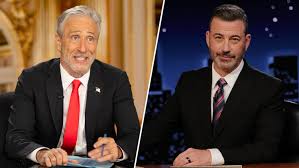
The cumulative effect of this late-night barrage was to transform a political flare-up into a shared cultural moment. Viewers across the country, many returning to work after a holiday weekend, were greeted by comedians incredulous that the president had spent his Thanksgiving airing insults and confusion. Through humor, these hosts provided a kind of reset, reminding audiences that while the political landscape can often feel chaotic, it can also be processed—slowly, sharply, and sometimes hilariously—through collective laughter.
By the end of Monday night’s programming, one thing was clear: Trump’s holiday-weekend behavior had once again placed him at the center of the late-night universe. Whether through Kimmel’s visual gags, Stewart’s heartfelt incredulity, or Colbert’s satire, the comedians made sure that audiences understood the stakes wrapped in the absurdity. And though Trump himself may shrug off their critiques, the conversations sparked by their humor will likely linger long after the holiday leftovers are gone.