


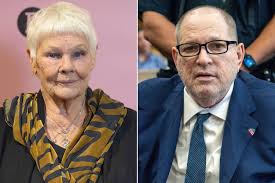
Judi Dench has never been a figure who courts controversy, yet she has never been one to retreat from honesty either. At 90 years old, the legendary actress—whose career spans Shakespeare, James Bond, and an era of global cinematic change—continues to speak with a frankness and emotional clarity that few public figures are willing to embrace. Her recent conversation with The Radio Times has ignited a new wave of discussion not because she offered a simplistic defense of fallen Hollywood titans, but because she dared to articulate something far more complicated: the tangled intersection between personal experience, public scandal, and the deeply human instinct to forgive.
The interview, which touched on Harvey Weinstein, Kevin Spacey, and the emotional legacies of relationships forged over decades, underscores something often overlooked in the broader #MeToo conversation—how personal history can live uncomfortably alongside public truth. Dench’s reflections don’t attempt to erase the pain of victims or rewrite the seriousness of allegations. Instead, they highlight the emotional challenges faced by those who knew accused individuals intimately but did not personally experience the misconduct described by others.
In an age that tends to demand immediate condemnation or unwavering loyalty, Dench’s willingness to live in the grey area offers a rare kind of emotional honesty. Her comments reveal the perspective of someone who has lived long enough to see careers rise and fall, reputations crumble, and the simple narratives of public discourse often unravel into something much more complex.
Her words have made headlines, but beneath the surface they tell a deeper story—one about time, humanity, and the difficult balance between acknowledging harm and recognizing the full span of a person’s life.
When Dench discussed Harvey Weinstein in her interview, she did so with careful thought. She made it clear that her own experiences with the disgraced film producer were positive, even career-shaping. Weinstein was behind some of her most acclaimed projects, and their relationship was, by her account, entirely free of the misconduct that nearly 90 women have since reported.
“I knew Harvey and I knew him well and worked with him, and I had none of that experience—very fortunately for me,” she said, acknowledging both her own luck and the gravity of the accusations others brought forward. She did not diminish their experiences; she simply recognized her own as different.
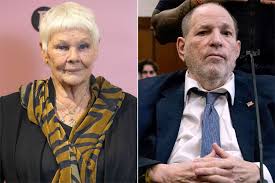
But the comment that drew the most attention was her observation that Weinstein may have “done his time.” She described seeing recent footage of him walking with two sticks, frail and altered from the powerful, imposing figure he once was. The physical transformation seemed to evoke an emotional response—a moment not of absolution, but of recognition that the man she once knew had been irrevocably changed.
Whether Dench meant that his years in prison count as having paid his debt, or that his complete ejection from the film industry constituted its own form of punishment, remains ambiguous. She offered the statement with hesitation, adding, “I don’t know, to me it’s personal—forgiveness.” It was an acknowledgment not of universal truth but of her own internal reckoning.
Weinstein, through his representatives, responded to Dench’s remarks with a rare note of appreciation. In a statement to USA TODAY, he called her “an extraordinary person who played an important role in my career.” He insisted on his innocence, stating that he is incarcerated “for something I did not do,” and expressed gratitude for her comments.
His response, like Dench’s, reflected a deeply personal history between two people whose professional lives intersected at pivotal moments. But it also reinforced the deep divide between Weinstein’s ongoing insistence on innocence and the many allegations that led to his downfall.
Dench’s comments were not a reopening of the debate about Weinstein’s guilt or innocence; they were a testament to the complicated emotional terrain people navigate when someone they once knew and trusted falls from grace.
The interview moved from Weinstein to another lightning-rod figure of the past decade: Kevin Spacey. Once celebrated as one of the greatest actors of his generation, Spacey has spent years in professional exile following multiple allegations of sexual misconduct beginning in 2017. Though several cases have gone to court, he has not been convicted by a jury.
For Dench, Spacey is not just a colleague—he is someone who supported her during one of the darkest moments of her life. After her husband Michael Williams died in 2001, Dench struggled deeply with grief. Spacey was among the people who helped pull her through.
“Kevin has been exonerated and I hear from Kevin, we text,” she said, noting that her contact with him today is rooted in gratitude and emotional connection. Her acknowledgment of their ongoing communication was another moment of honesty—one that few public figures would be comfortable sharing given the controversies attached to his name.
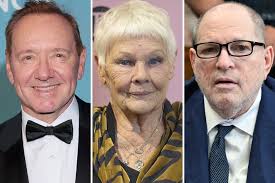
In many ways, her loyalty to Spacey mirrors the personal complexity of her comments about Weinstein. Dench does not deny the seriousness of the allegations that were made against him. Instead, she recognizes that her direct experience of the man stands in contrast to the stories that emerged years later.
Spacey himself, speaking recently to The Telegraph, described his life today as nomadic and financially strained. “I’ve had very little coming in and everything going out,” he said, explaining that he now lives primarily in hotels and Airbnbs while taking whatever work he can find. “I literally have no home,” he added, framing his situation as one of personal and professional fallout from years of public scrutiny.
His emergence from court cases without convictions hasn’t restored his career, and he remains largely